
Dental Implants in Surat
Dental Implants
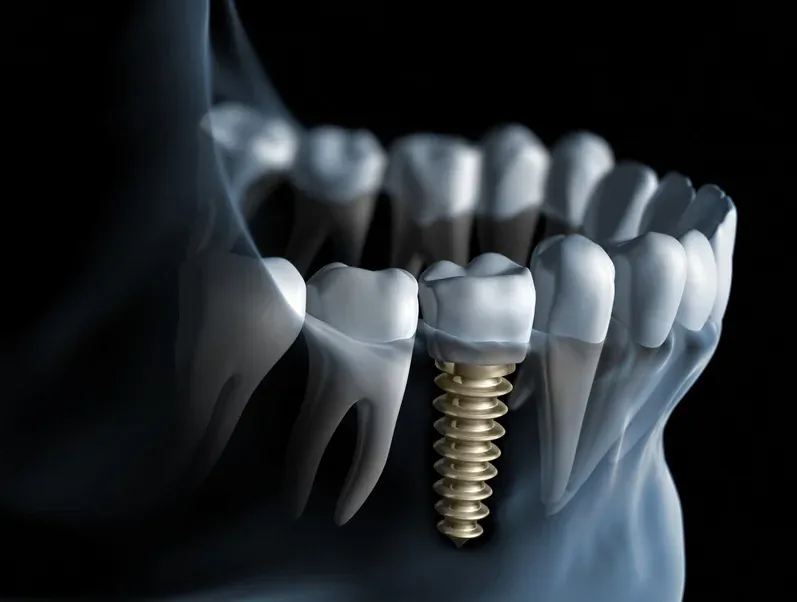
A dental implant is a small, biocompatible post placed in the jawbone to support a replacement tooth. For many people with missing teeth, implants offer a stable, fixed alternative to removable dentures — but suitability depends on a careful assessment of your bone, gums and general health.
Treatment overview
An implant restoration usually has three parts: the implant post, which sits in the bone; an abutment, which connects to it; and the visible crown, bridge or denture that is attached on top. Over several weeks to months, the bone generally bonds with the implant surface, a process known as osseointegration.
Implants can replace a single tooth, several teeth or, in some cases, support a full arch. Because they do not rely on neighbouring teeth for support, the adjacent teeth usually do not need to be reshaped as they might for a conventional bridge.
Why patients discuss this treatment
- One or more teeth are missing because of decay, gum disease or injury
- A removable denture feels loose or uncomfortable
- You would prefer not to have healthy neighbouring teeth prepared for a bridge
- Gaps are affecting chewing comfort or confidence when smiling
These are common reasons only. Only an examination can determine whether this treatment is appropriate for you.
Assessment & treatment journey
- 1
Consultation & examination
Your dentist reviews your dental and medical history, examines the area and discusses your goals and alternatives.
- 2
Imaging & planning
X-rays and, where appropriate, digital scans help assess bone volume and nearby structures so the implant position can be planned.
- 3
Implant placement
The implant is placed under local anaesthesia. Some cases may first need extraction healing or bone grafting.
- 4
Healing period
The bone is given time to integrate with the implant. A temporary tooth may be provided in some situations.
- 5
Final restoration
Once healing is confirmed, a custom crown, bridge or denture is fitted and your bite is checked.
Potential benefits
- Fixed replacement that does not need to be removed for cleaning
- Neighbouring teeth generally do not need to be prepared
- Can help restore chewing function and the appearance of your smile
- Helps maintain the bone in the area of the missing tooth
Limitations & considerations
- Requires minor surgery and a healing period of several weeks to months
- Not everyone is suitable — bone volume, gum health, smoking and some medical conditions affect outcomes
- Implants can fail or develop complications such as peri-implantitis
- Long-term success depends heavily on home care and regular reviews
Aftercare
- Follow the post-operative instructions given to you, including any advice on swelling, diet and medication
- Brush and clean around the implant daily, using interdental brushes or floss as shown by your dentist
- Avoid smoking, which is associated with poorer healing
- Attend regular check-ups so the implant, gums and bite can be monitored
This information is general and educational. It does not replace an examination or individual advice from a qualified dental professional. Treatment suitability, risks, recovery and results vary from person to person.
FAQs
Dental Implants: common questions
General information only — your dentist will advise on your individual situation.
See all FAQsAppointments by phone
Ready to talk to a dentist?
Call either branch and our team will help you arrange a visit at a time and location that suits you.
Main clinic
Ground Floor 16 - Western Business Hub, Pratham Circle, Green City Road, Pal-Adajan, Surat, Gujarat - 395009
075674 26242 Directions to Dental Planet — Pal-Adajan (opens Google Maps)Second branch
G-3 Sachi Complex, Rughnathpura Main Road, Near Lal Darwaja, Surat, Gujarat
84695 40350 Directions to Dental Planet — Lal Darwaja (opens Google Maps)